
Continuation
Designing how contribution evolves across long professional arcs
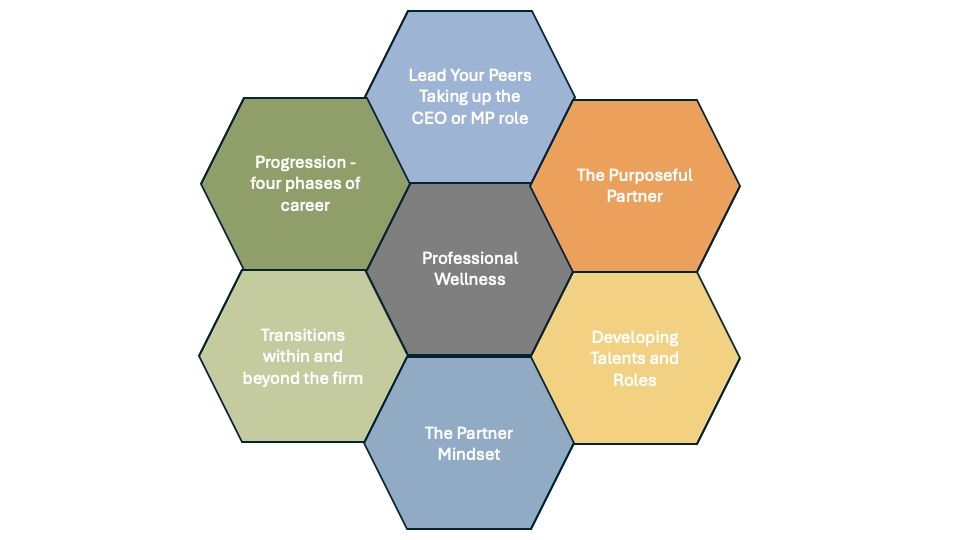
Continuation: The Core Discipline in Partner Career Strategy
In Brief:
- In most firms, the shape of a partner's career is taken for granted, especially after the first decade.
- Yet strong individual career strategies, aligned with a strategy to shape a strong partner cohort, is key to sustained success.
- This board-level issue is challenging for mid-sized firms.
- The Continuation Studio creates space for senior partners to design what's needed according to the firm's culture, existing cohort and key issues.
- Some outcomes resolve issues of succession, strategic capability and risk reduction.
1. The first partner phase is heavily designed. The long arc rarely is.
The pressure in most professional firms is to design the front end of the partner career arc carefully. Processes from nomination through assessment and induction are designed to manage risk and establish performance expectations. This shapes how people enter partnership and build momentum in the early years.
As contribution evolves across the long middle and later phases of partnership, an equivalent level of design finesse is needed. But it is rare. Contribution is still largely defined through tangible metrics, which pushes partners to shape their career strategy within short-term performance cycles. At the same time, responsibility, authority and influence continue to grow and need to evolve in line with the firm’s shifting strategic priorities.
This creates a predictable gap between what firms need and how individual partners shape their careers. At Board level, firms focus on equity balance, succession, leadership depth and client continuity. Individually, partners experience their careers through contribution, status, timing and influence. Both perspectives are rational. Without a shared design frame at key milestones, they diverge and create unnecessary stress. That often happens just when contribution could be most valuable.
I use the term Continuation to name this core discipline. It concerns the deliberate design of how contribution, authority and influence evolve across long professional arcs — in ways that serve both the firm’s strategy and the individual’s development over time. Continuation treats transitions within the firm and beyond the firm as part of one strategic professional and business development process. It is a career strategy discipline that applies from admission through to later phases of contribution. Continuation is not about how people enter partnership or how equity is allocated; it concerns how contribution is designed to evolve once partnership is achieved.
2. When momentum substitutes for design
There are many reasons firms and partners struggle to locate the source of problems when their strategy struggles. The momentum created by client pull often gets mistaken for deliberate strategic intent. Seniority can confer privilege without a corresponding redesign of responsibility. Reputation quietly erodes after it has stopped being refreshed. Roles shaped for one environment become irrelevant as the entire context changes.
These patterns tend to be exposed during strategic shocks. Over the past 15 years — through the GFC, the Covid period, and ongoing technological and geopolitical disruption — momentum has often looked robust until the context shifted. When that happens, the absence of design shows up as rigidity and blindness to new directions.
In the absence of deliberate design, unhelpful behaviours emerge. Senior partners protect familiar territory rather than reshaping their contribution. Client and talent relationships become sources of personal leverage rather than vehicles for succession. Boards can become reactive, leaning on outdated processes or defaulting to short-term expediency. These are not personal failings; they are predictable outcomes when momentum is mistaken for design.
3. Why firms invest in parts of the arc — and neglect the rest
Firm cultures embody implicit assumptions about what a professional career looks like, shaped by their history, leadership cohort and commercial model. In some firms, leadership is relatively young and retirement is expected in the mid-fifties. In others, Boards include newly admitted partners alongside elders, with no formal retirement age. In some contexts, lateral moves are routine. In others, they are experienced as disruption.
These differences matter because they shape where firms choose to invest. Resources tend to flow to the phases of the career arc that promise the most visible return: rapid growth, new revenue streams, or peak profitability. Other phases receive less considered attention, even when they carry significant strategic value over time.
Partner reward structures can further reinforce short-term performance logic over longer-term strategic logic. This tension is familiar in performance reviews and Board–partner interactions. It is not a flaw in governance; it is a predictable outcome of incentive design.
From a governance perspective, admission to partnership is a more definable and controllable process than guiding how a partner’s contribution evolves over decades. As a result, transitions are often handled ad hoc. This applies not only to transitions out of the firm, but also to transitions within it — into practice leadership or governance roles — where appointments can be rushed, role definition thin, and induction limited.
Partners are, by nature, perceptive, skilled and resilient, so firms often “get through” these moments. But getting through is not the same as designing well. Deliberate design of Continuation would yield more coherent outcomes across the firm and over time.
These patterns accumulate into structural weaknesses that are difficult to correct under pressure.
4. Continuation sits with the Board, not with HR
Responsibility for design ultimately rests with the top layer of any organisation. In corporates and professional firms alike, it is often tempting to push design problems down to where symptoms surface — diagnosing them as HR issues, operational failures, or the behaviour of “old-school” partners approaching transition.
Design, and the consequences of design choices, sit with the Board. At this level, design is complex and uncertain because crossover effects are inescapable. Technology affects delivery. Delivery shapes client experience and marketing. These, in turn, influence talent attraction and retention. Design decisions propagate across the whole system.
The kinds of questions that emerge when Boards adopt a design perspective include:
- How and why should we gauge success beyond easily measured billings?
- What non-financial contributions matter most, and over what time horizons?
- What does equity mean in practice — ownership, dividend rights, seniority, voting power, or something else?
- What role could alumni play in strengthening our professional community and client relationships?
- Does our approach to professional development align with what we know about human development over long careers?
When I pose questions like these, Boards often offer thoughtful answers grounded in decades of experience. That experience matters. At the same time, well-framed design questions can unlock new strategic possibilities. Boards shape the culture that attracts and develops talent. They craft performance models that reward results without exhausting the firm’s long-term capacity. And they design leadership pathways that allow the right leaders to emerge for the challenges ahead.
5. What failure looks like when Continuation is left undesigned
Across the last three decades, I’ve seen recurring symptoms of poorly designed Continuation:
- The ‘empty decade’ phenomenon – an entire layer of the firm is thin or missing because partners weren’t appointed or developed at the right time, creating a gap just when renewed leadership is needed.
- Board appointments that reflect cliques rather than complementary talents.
- Loss of entire practices to rival firms because of perceived imbalance in partner reward structures.
- Former partners, now in influential client roles, quietly directing fees away from their alumnus firm.
- Litigation as the default exit process.
Each of these situations feels intensely personal and emotional. Yet taken together, they point to structural design failings rather than individual shortcomings. They prompt a simple question, ‘could this have been designed better?’
6. Reframing the issue: Continuation as career strategy
Continuation is not about moving people to their “next role” or reinventing professional identities. It is a design discipline concerned with how contribution evolves over long professional arcs — within firms and, eventually, beyond them.
At an individual level, Continuation helps explain why different partners are suited to different forms of contribution over time: client leadership, practice development, governance roles, innovation, or mentoring in depth. This is not a matter of ambition or preference alone. It reflects how the firm enables partners to develop their authority, influence and innate strengths.
At a firm level, Continuation acknowledges the entwined nature of personal development and organisational design in professional firms. It provides a frame for aligning individual career strategy with the firm’s evolving strategic needs, rather than leaving this alignment to informal negotiation or short-term performance cycles.
Seen this way, Continuation is not a retirement framework, not an HR program, and not reinvention in disguise. It is a strategic design discipline, grounded in strengths and in the long-term capacity of professional firms to contribute value over time.
7. Why this matters now
Professional firms are operating under systemic pressure. Demographic shifts mean that newer generations of professionals bring different expectations about contribution, meaning at work, organisational loyalty and career strategy. This challenges assumptions that many firms have treated as foundational.
These shifts are not occurring in isolation. The professional services business model itself is under strain. Questions are being asked about the partnership structure, the leverage model, and how technologies such as AI affect not only productivity, but the formation of professional judgement and the transfer of tacit knowledge.
In this context, a firm’s strength lies not only in the accumulated capability of its partners, but in the design that enables that capability to be developed and expressed over decades. Continuation becomes a strategic asset: a way of sustaining authority, contribution and professional judgement as the context in which firms operate continues to change.
I work with firms and partners on career strategy and Continuation — designing how contribution evolves across long professional careers. If you’re interested in comparing notes, I’m always open to a conversation.
The Continuation Studio
A peer design space for shaping long professional arcs
Learn about the Continuation Studio